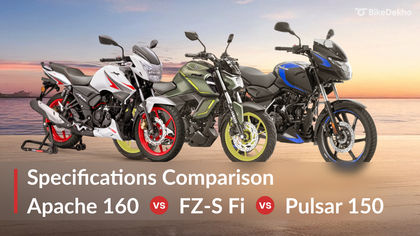
Bajaj Pulsar 150 vs TVS Apache RTR 160 vs Yamaha FZ-S Fi: Specifications Comparison
Here’s how the updated Pulsar stacks up against the other original sporty 150cc bikes
Bajaj recently refreshed the Pulsar 150 with a new face, all-LED lighting, and new colour schemes – giving the iconic nameplate a modern touch. The Bajaj Pulsar 150 continues to be one of India’s most recognisable sporty commuters. We compare the top variant against two of its closest rivals: the TVS Apache RTR 160 2V and Yamaha FZ-S Fi STD. On paper, all three target everyday riders seeking a balance of performance, practicality and style.
Engine|
Specifications |
Bajaj Pulsar 150 |
TVS Apache RTR 160 |
Yamaha FZ-S Fi |
|
Engine |
149.5cc, single-cylinder, air-cooled, 2-valve engine |
159.7cc, single-cylinder, air-cooled, 2-valve engine |
149cc, single-cylinder, air-cooled, 2-valve engine |
|
Power |
14PS @ 8,500rpm |
16.04PS @ 8,750rpm |
12.4PS @ 7,250rpm |
|
Torque |
13.4Nm @ 6,500rpm |
13.85Nm @ 7,000rpm |
13.3Nm @ 5,500rpm |
|
Gearbox |
5-speed |
||
The TVS Apache RTR 160 is clearly the most powerful motorcycle here, thanks largely to its bigger displacement and performance-oriented tuning. The higher peak output suggests stronger top-end performance compared to the other two. That said, outright power isn’t the sole indicator of real-world pace. The Pulsar 150 sits comfortably in the middle, offering a balanced spread of power without chasing outright numbers. The Yamaha FZ-S Fi is the least powerful on paper, but its torque arrives earlier in the rev range, focused on easy rideability and relaxed urban use.
Underpinnings
|
Specifications |
Bajaj Pulsar 150 |
TVS Apache RTR 160 |
Yamaha FZ-S Fi |
|
Frame |
Double cradle |
||
|
Front suspension |
Telescopic fork |
||
|
Rear suspension |
Twin rear gas charged shocks |
7-step adjustable monoshock |
|
|
Front brake |
280mm disc |
270mm disc |
282mm disc |
|
Rear brake |
230mm disc |
240mm disc |
220mm |
|
Front tyre |
90-section |
100-section |
|
|
Rear tyre |
120-section |
140-section |
|
All three bikes use conventional hardware layouts, though their setups differ in intent. The FZ-S Fi stands out with its monoshock, offering more adjustability on paper compared to the other two. The Yamaha also rolls on wider tyres at both ends. While the Bajaj bike and FZ-S have larger front disc brakes, the TVS Apache bike gets dual-channel ABS – making it the safest option here.

Dimensions
|
Specifications |
Bajaj Pulsar 150 |
TVS Apache RTR 160 |
Yamaha FZ-S Fi |
|
Ground clearance |
165mm |
180mm |
165mm |
|
Fuel tank capacity |
15-litres |
12-litres |
13-litres |
|
Seat height |
785mm |
790mm |
|
|
Kerb weight |
150kg |
139kg |
137kg |
Weight plays a crucial role in daily usability and performance, and here the Yamaha FZ-S is the lightest, followed closely by the Apache 160. The Bajaj Pulsar bike is noticeably heavier, which may affect manageability for some riders. Seat heights are fairly similar across the trio, remaining approachable for most riders. The TVS bike’s higher ground clearance stands out, making it better suited to rough urban roads and speed breakers.
Features
|
Feature |
Bajaj Pulsar 150 |
TVS Apache RTR 160 |
Yamaha FZ-S Fi |
|
LCD console |
Yes |
||
|
Bluetooth connectivity |
|||
|
Turn-by-turn navigation |
No |
Yes |
No |
|
Lighting |
All-LED |
LED headlight & tail lamp, halogen indicators |
All-LED |
|
Ride Modes |
No |
3 (Rain, Urban, Sport) |
No |
|
ABS |
Single-channel |
Dual-channel |
Single-channel |
|
Traction control |
No |
Yes |
|
While all three bikes get LCD consoles, the TVS Apache 160 clearly leads here with turn-by-turn navigation, ride modes, dual-channel ABS, and ‘Glide Through Technology’. GTT allows you to ride the bike without any throttle input at low speeds in the first 3 gears. The updated Pulsar 150’s highlights are its new LED headlight and indicators. The Yamaha FZ bike also gets all-LED lighting, and traction control – a feature not offered by anyone else in the 150-160cc space.
Price & Verdict
|
Bajaj Pulsar 150 Twin Disc Upgraded |
TVS Apache RTR 160 Dual Channel ABS |
Yamaha FZ-S Fi STD |
|
Rs 1,15,481 |
Rs 1,23,990 |
Rs 1,23,963 |
(all prices ex-showroom)
The Pulsar 150 offers the most accessible pricing, while the Apache 160 justifies its higher price with more features and safety. The Yamaha bike commands a premium for its perceived brand value and build quality. Based purely on specifications, the Apache appears the most well-rounded, though the comparo warrants a proper road test before choosing a clear favourite – so stay tuned!
User Reviews
It is a very good bike for racing, but the maintenance cost is high. Otherwise, the bike is excellent. The waist catches on it, but the brake control is very good. Chain problems are very common. Whether the pickup is low or high, it performs well.Read More
Super bike, best mileage and comfortable seat. लंबी दूरी के सफर के दौरान पीठ या कमर दर्द की समस्या आम होती है, लेकिन यह बाइक की आरामदायक सीट और बेहतरीन सस्पेंशन सिस्टम (Suspension System) गड्ढों और झटकों को आसानी से सहन कर लेते हैं। इसके डिस्क ब्रेक और आधुनिक ब्रेकिंग सिस्टम से सुरक्षा का पूरा भरोसा मिलता है, जिससे अचानक ब्रेक लगाने पर भी बाइक नियंत्रण में रहती है।Read More
Ye sir ek bike nahi hai, style, power and royal personality ka best combination hai. It gives good average, aggressive look, road par ek nayi pehchan deti hai. Yamaha naam hi kafi hai, yamaha ke engine pehle hi kafi reliable hote hai.Read More
Got it in a reasonable price, gives good mileage on highway 60kml and in city moderate traffic 50 to 55 km/l and heavy traffic 45 to 50 km/l. Maintenance cost is also budget friendly, good maintained bike. Every service is done in the showroom. Comming to performance, it gives me a good performance. Read More