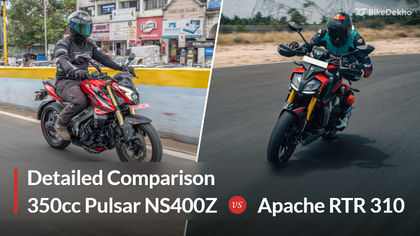
350cc Bajaj Pulsar NS400Z vs TVS Apache RTR 310: Detailed Comparison
Affordable performance meets premium technology: which streetfighter offers more for your money?
The Bajaj Pulsar NS400Z and TVS Apache RTR 310 cater to riders looking for a sporty naked motorcycle, but they take different approaches to performance and features. Their differences extend beyond their engine specifications. The two motorcycles vary in dimensions, braking hardware, weight, equipment and pricing, which can influence their suitability for different riding styles. Here's how they compare across the key parameters.
Price & Variants
|
Bajaj Pulsar NS400Z |
TVS Apache RTR 310 |
||
|
Colours |
Ex-showroom Price |
Colours |
Ex-showroom Price |
|
Brooklyn Black |
Rs 1,91,254 |
Arsenal Black Base without QuickShifter |
Rs 2,29,990 |
|
Pearl Metallic White |
Arsenal Black Base |
Rs 2,46,990 |
|
|
Glossy Racing Red |
Fury Yellow Base |
Rs 2,46,990 |
|
|
Pewter Grey |
Black Diamond Edition Base |
Rs 2,48,990 |
|
|
Fiery Red Base |
Rs 2,51,990 |
||
|
Sepang Blue Base |
Rs 2,52,990 |
||
|
Anniversary Edition |
Rs 2,97,290 |
||
-
The Pulsar NS400Z has a clear advantage in terms of affordability, with its ex-showroom price of Rs 1,91,254. The Apache RTR 310’s prices start at Rs 2,29,990, making it Rs 38,736 more expensive than the Pulsar. This difference makes the NS400Z a more accessible option for riders who want a performance-oriented motorcycle without spending as much.
-
The price gap becomes more substantial when comparing the Pulsar NS400Z with the higher-priced Apache RTR 310 variants. The Anniversary Edition costs Rs 2,97,290, which is Rs 1,06,036 more than the Pulsar.

Dimensions & Design
|
Specifications |
Bajaj Pulsar NS400Z |
TVS Apache RTR 310 |
Difference |
|
Wheelbase |
1,346mm |
1,358mm |
+ 12mm |
|
Ground clearance |
165mm |
180mm |
+ 15mm |
|
Fuel tank capacity |
12 litres |
11 litres |
- 1 litre |
|
Seat height |
805mm |
800mm |
- 5mm |
|
Kerb weight |
176kg |
169kg |
- 7kg |
-
The Apache RTR 310 has a 12mm longer wheelbase than the Pulsar NS400Z. A longer wheelbase generally helps a motorcycle remain stable at higher speeds, which can be useful during highway rides. The Pulsar's shorter wheelbase, meanwhile, may make it feel more responsive when changing direction or manoeuvring through congested city traffic.
-
Ground clearance is another area where the Apache RTR 310 has an advantage. Its 180mm clearance is 15mm higher than the Pulsar NS400Z's 165mm. The additional clearance gives the Apache more room underneath when negotiating tall speed breakers, uneven roads and other obstacles.
-
The Pulsar NS400Z gets a larger 12-litre fuel tank, compared to the Apache RTR 310's 11-litre unit. The extra litre gives the Pulsar a potential advantage in terms of more range between fuel stops.
-
The Apache RTR 310 has a seat height of 800mm, which is 5mm lower than the Pulsar NS400Z's 805mm. Although the difference is small, the Apache may slightly be more accessible for some riders, particularly when stopping in traffic or manoeuvring the motorcycle at low speeds.
-
At 169kg, the Apache RTR 310 is 7kg lighter than the Pulsar NS400Z. This lower kerb weight can make the Apache easier to move around in tight spaces and may help when making quick changes in direction. The weight difference can also be useful when handling the motorcycle while parking or navigating slow-moving traffic.
-
In terms of styling, the Pulsar NS400Z follows the established NS family design language, with muscular body panels, sharp lines and an aggressive streetfighter stance. The Apache RTR 310 takes a more futuristic approach, featuring angular design lines and a compact rear section.
Underpinnings
|
Specifications |
Bajaj Pulsar NS400Z |
TVS Apache RTR 310 |
|
Front suspension |
43mm inverted fork |
Upside-down fork |
|
Rear suspension |
Monoshock |
Monoshock |
|
Front brake |
320mm disc brake |
300mm disc brake |
|
Rear brake |
230mm disc brake with dual-channel ABS |
240mm disc brake with dual-channel ABS |
|
Front tyre |
110/70-17 |
110/70 - R17 |
|
Rear tyre |
150/60 - 17 |
150/60 - R17 |
-
Both motorcycles get an upside-down front fork and a rear monoshock.
-
The Pulsar NS400Z gets a larger 320mm front disc, compared to the Apache RTR 310's 300mm unit. A larger disc can provide better braking performance, depending on the caliper, pad material and overall brake setup. However, disc diameter alone is not enough to determine actual stopping power.
-
At the rear, the Apache RTR 310 has a 240mm disc, which is 10mm larger than the Pulsar NS400Z's 230mm unit. Both motorcycles come with dual-channel ABS, which helps prevent the front and rear wheels from locking under hard braking.
-
Both streetfighters use identical tyre dimensions: 110/70-17 at the front and 150/60-17 at the rear.
Features
|
Specifications |
Bajaj Pulsar NS400Z |
TVS Apache RTR 310 |
|
Full-LED lighting |
Yes |
Yes |
|
Bluetooth connectivity |
Yes |
Yes |
|
USB charging |
Yes |
Yes |
|
Instrument Console |
TFT |
TFT |
-
Both motorcycles feature full-LED lighting, Bluetooth connectivity, USB charging and a TFT instrument console.
-
The Pulsar NS400Z gets a 5-inch TFT instrument console with smartphone connectivity, Google Maps mirroring, music controls, navigation, document storage and a lap timer. The motorcycle also gets four riding modes: Road, Rain, Sport and Off-Road, which adapt its power delivery and braking performance to different riding conditions.
-
The Pulsar NS400Z also features traction control to help limit rear-wheel spin during acceleration. Its Sports Shifter enables clutchless gear changes, while Panic Brake Alert rapidly flashes the lights during hard braking to warn vehicles following behind.
-
The Apache RTR 310 has a more extensive features package. It has a 5-inch TFT display. Through TVS SmartXonnect, riders can access smartphone connectivity, ride information and post-ride analysis. The console also supports music controls, different themes and display settings.
-
The Apache RTR 310 offers five riding modes, allowing riders to adapt its behaviour to different conditions. A bidirectional quickshifter is also available, allowing clutchless upshifts and downshifts for quicker gear changes.
-
Another notable feature in the Apache RTR 310 is cruise control, which helps maintain a certain speed without requiring continuous throttle input. This can reduce effort during longer highway journeys. The motorcycle also offers Glide Through Technology, which allows it to move at low speeds with gradual clutch release without the rider needing to apply the throttle, helping in slow-moving traffic.
-
The Apache RTR 310's more advanced rider aids include cornering ABS and cornering traction control. Other features include wheelie control, rear-wheel lift protection and cornering cruise control.
-
The Apache RTR 310 also offers climate-controlled seats with heating and cooling functions designed to improve comfort in different weather conditions. Adjustable levers allow riders to customise the reach of the controls, while GoPro integration lets compatible cameras be controlled through the motorcycle's switches. These features give the Apache a more features-focused character than the Pulsar NS400Z.
-
Overall, the Pulsar NS400Z covers the essentials well and offers useful features such as multiple riding modes, traction control, connected navigation and a quickshifter. The Apache RTR 310 goes further with a wider range of electronic rider aids, cruise control, climate-controlled seats and additional connectivity options. It therefore has the advantage in terms of features.
Performance
|
Specifications |
Bajaj Pulsar NS400Z |
TVS Apache RTR 310 |
|
Engine |
349.13cc, single-cylinder, liquid-cooled engine |
312cc, single-cylinder, liquid-cooled engine |
|
Power |
40.6PS at 9,000rpm |
35.6PS at 9,700rpm |
|
Torque |
33.2Nm at 7,500rpm |
28.7Nm at 6,650rpm |
|
Gearbox |
6-speed with slipper clutch |
6-speed with slipper clutch |
-
The Pulsar NS400Z has a clear advantage in terms of engine output. Its 349.13cc engine produces 40.6PS, compared to the Apache RTR 310's 35.6PS. The difference of 5PS gives the Pulsar an advantage on paper, particularly when stronger acceleration and outright performance are priorities.
-
Torque figures also favour the Pulsar NS400Z. It produces 33.2Nm, while the Apache RTR 310 delivers 28.7Nm. The Pulsar's 4.5Nm advantage can help provide stronger pulling power, which may be useful when accelerating out of corners, overtaking or riding with a pillion.
-
The Pulsar NS400Z develops its peak power at 9,000rpm, whereas the Apache RTR 310 reaches its maximum output at 9,700rpm. This indicates that the Apache needs to rev higher to reach its peak power figure.
-
The Apache RTR 310 produces its peak torque at 6,650rpm, which is lower than the Pulsar NS400Z's 7,500rpm. This means the Apache reaches its maximum torque at a lower engine speed, although the Pulsar produces more torque overall.
-
Both motorcycles get six-speed gearboxes paired with slipper clutches. A slipper clutch helps reduce rear-wheel hop during aggressive downshifts, while the six-speed transmission gives riders a range of ratios for city riding and highway cruising..
-
On paper, the Pulsar NS400Z is the stronger performer, with higher power and torque figures.
Verdict
The Bajaj Pulsar NS400Z is the more affordable option and delivers higher power and torque than the TVS Apache RTR 310. Its larger fuel tank, lower price tag and performance-focused character make it a compelling choice for riders who want a powerful streetfighter for everyday use and spirited riding. It also offers useful features, including multiple riding modes, traction control and smartphone connectivity.
The TVS Apache RTR 310 is better suited to buyers who want a more features-focused motorcycle. It is lighter, has higher ground clearance and comes with a more extensive range of electronic rider aids and convenience features. Its lower seat height may also make it slightly more accessible to some riders.
Ultimately, the Pulsar NS400Z makes more sense for buyers who prioritise performance and affordability, while the Apache RTR 310 is worth considering for those willing to pay more for additional technology, rider aids and convenience features.
User Reviews
If you’ve been dreaming of owning a high-performance, head-turning sport bike without blowing your entire savings, the Bajaj Pulsar NS400Z is the game-changer you've been waiting for. It’s not just another Pulsar—it is currently the most accessible and value-for-money 400cc motorcycle on the market today.Read More
this bike is so good . I mostly like the design of this bike and so comfortable . The power of this bike is awesome . The overall style I like most . When you ride this bike you shall feel like a racer . There is ventilated seat in this bike and Digital instrument cluster also . You can go long drive with this bike and it is a TVS bike so don't judge this bike . Ride this bike like a racer .Read More