TVS RTR 125 vs Yamaha MT125: Detailed Comparison
The TVS RTR 125 and Yamaha MT125 are closely matched on performance, but their hardware and features packages set them apart
The TVS RTR 125 and Yamaha MT125 are two sporty 125cc motorcycles with similar engine outputs and several common features, including liquid-cooled engines, inverted front forks, disc brakes at both ends and 5-inch TFT displays. However, they differ in some important areas. Here's how the two motorcycles compare in terms of design, features, hardware and performance.
Design
-
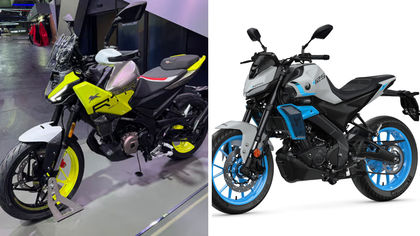
The TVS RTR 125 and Yamaha MT125 both follow an aggressive streetfighter design, but their styling approaches are quite different. The RTR 125 has a sharp front end with angular DRLs and a projector LED headlight. It also gets a tall transparent windscreen, a relatively compact fuel tank with large extensions, and a split-seat setup.
-
The Yamaha MT125, meanwhile, follows the familiar design language of the MT range. The 2027 model gets a redesigned fuel tank, a leaner silhouette and updated side panels with textured detailing and a smoked, translucent finish.

Underpinnings
|
Specifications |
TVS RTR 125 |
Yamaha MT125 |
|
Front suspension |
KYB Inverted fork |
Inverted fork |
|
Rear suspension |
KYB Monoshock |
Monoshock |
|
Front brake |
Disc brake |
Disc brake |
|
Rear brake |
Disc brake |
Disc brake |
-
Both motorcycles get inverted front forks and a rear monoshock setup, which should offer better control over uneven surfaces and during cornering than telescopic forks. The Yamaha MT125 has a 41mm front fork with 130mm of travel while the RTR 125 uses KYB units at both ends.
-
The Yamaha MT125 gets a 292mm front disc with a radial-mount caliper and a 220mm rear disc. This is a relatively premium braking setup for a 125cc motorcycle and should offer good braking feel and control. The RTR 125 also gets disc brakes at both ends, with ByBre calipers.
-
The RTR 125 gets switchable dual-channel ABS. The Yamaha MT125 also gets dual-channel ABS, along with a traction control system that helps reduce rear-wheel slip on slippery surfaces.
Features
|
Specifications |
TVS RTR 125 |
Yamaha MT125 |
|
Full-LED lighting |
Yes |
Yes |
|
Bluetooth connectivity |
Yes |
Yes |
|
USB charging |
Yes |
Yes |
|
Instrument Console |
5-inch TFT display |
5-inch TFT display |
|
ABS |
Switchable dual-channel ABS |
Dual-channel ABS |
-
Both motorcycles get full-LED lighting and a 5-inch TFT instrument console. The RTR 125's display supports Google Maps mirroring and other connectivity functions, while the MT125's colour TFT gets three selectable display themes and smartphone connectivity through Yamaha's MyRide app. The latter also supports turn-by-turn navigation, along with call, message and music information.
-
The RTR 125 gets ride modes, which allow the rider to alter the motorcycle's response. Yamaha has equipped the MT125 with a traction control system, which uses data from the rear-wheel sensor to help reduce the chances of the rear wheel slipping.
Performance
|
Specifications |
TVS RTR 125 |
Yamaha MT125 |
|
Engine |
125cc, 4-valve, liquid-cooled DOHC |
125cc, single-cylinder, liquid-cooled engine |
|
Power |
14.9 PS at 9,000rpm |
15PS at 10,000rpm |
|
Torque |
12Nm at 7,000rpm |
11.5Nm at 8,000rpm |
|
Gearbox |
6-speed with slipper clutch |
6-speed with slipper clutch |
-
Both motorcycles get 125cc, liquid-cooled, four-valve engines, but their engine configurations differ. The RTR 125 gets a DOHC setup, while the MT125 uses a SOHC engine with Yamaha's Variable Valve Actuation (VVA) technology. The latter switches between different intake cam profiles to balance low- and high-rpm performance.
-
The Yamaha MT125 produces 15PS, giving it a marginal 0.1PS advantage over the RTR 125's 14.9PS. However, the RTR 125 develops 12Nm, which is 0.5Nm more than the MT125's 11.5Nm. It also produces its peak torque at a lower 7,000rpm, compared to the MT125s 8,000rpm. This could give the RTR 125 a slight advantage in terms of mid-range response, while the MT125 makes its peak power and torque higher up the rev range.
-
Both motorcycles get a 6-speed gearbox and an assist and slipper clutch. This setup should make gear changes smoother and help reduce rear-wheel hopping during aggressive downshifts.
Verdict
The TVS RTR 125 and Yamaha MT125 are closely matched in terms of engine performance, with the Yamaha producing marginally more power and the TVS offering slightly higher torque. Both get liquid-cooled four-valve engines, inverted front forks, disc brakes at both ends and 5-inch TFT displays.
On paper, the MT125 has an advantage in terms of its suspension and braking setup, while the RTR 125 offers a slightly higher torque output and switchable ABS. The final choice between the two would depend on whether a rider prefers the Yamaha's premium equipment and traction control or the TVS's features list and marginally stronger torque output.