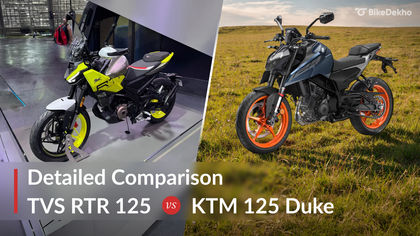
TVS RTR 125 vs KTM 125 Duke: Design, Underpinnings, Features, And Powertrains Comparison
The RTR 125 takes on the 125 Duke with a liquid-cooled engine, KYB suspension and an impressive list of features
The KTM 125 Duke has long been known for bringing styling from the larger Dukes and premium hardware to the entry-level motorcycle segment. The TVS RTR 125 now enters the picture with a similar focus on performance, offering a liquid-cooled engine, inverted forks and a six-speed gearbox. With both motorcycles also featuring TFT displays, ride modes and dual-channel ABS, here's how they stack up against each other.
Design
The TVS RTR 125 and the KTM 125 Duke follow the same basic streetfighter formula, with sharp bodywork, exposed frames and compact rear sections. However, their styling details give them distinct identities.
The RTR 125 has a relatively compact fuel tank with large, sharply sculpted tank extensions that give its front section a muscular appearance. Its aggressive front end features a projector LED headlight with sharp DRLs, while the tall transparent windscreen adds to its distinctive look. The motorcycle also gets a split-seat setup, a sporty trellis frame and a cast swingarm. The lime green and metallic grey dual-tone finish showcased at EICMA further highlights its sharp bodywork.
The 125 Duke, meanwhile, carries KTM's familiar aggressive design language. Its sharp body panels, visible air intakes and angular headlight surround give it a muscular appearance.

Underpinnings
|
Specifications |
TVS RTR 125 |
KTM 125 Duke |
|
Front suspension |
KYB Inverted fork |
Inverted fork |
|
Rear suspension |
KYB Monoshock |
Monoshock |
|
Front brake |
Disc brake |
Disc brake |
|
Rear brake |
Disc brake |
Disc brake |
-
Both motorcycles get inverted front forks, but the 125 Duke has a 43mm WP APEX open-cartridge unit with 150mm of travel. This is a very premium suspension package for a 125cc motorcycle and is designed to provide better control over uneven surfaces while maintaining front-end stability during hard braking and cornering.
-
Both bikes also get a rear monoshock, but their hardware differs. The RTR 125 gets a KYB unit, while the 125 Duke gets a WP APEX Separate piston shock absorber with 150mm of travel.
-
Both motorcycles get disc brakes at either end. The RTR 125 uses ByBre calipers, while the 125 Duke gets a 320mm front disc with a four-piston radial caliper and a 240mm rear disc with a single-piston caliper. The larger front disc on the KTM should offer strong braking performance.
-
The 125 Duke's larger brake discs are also designed to manage heat more effectively during repeated braking, helping reduce the chances of brake fade. This can be particularly useful when riding aggressively or braking hard on winding roads.
-
Both motorcycles have dual-channel ABS, but the 125 Duke gets Cornering ABS and Supermoto ABS as standard. Cornering ABS takes the motorcycle's lean angle into account while regulating braking intervention, helping maintain stability when braking through a turn. Supermoto ABS allows the rear ABS intervention to be disengaged for riders who want more freedom to slide the rear wheel.
Features
|
Specifications |
TVS RTR 125 |
KTM 125 Duke |
|
Full-LED lighting |
Yes |
Yes |
|
Bluetooth connectivity |
Yes |
Yes |
|
USB charging |
Yes |
Yes |
|
Instrument Console |
5-inch TFT display |
5-inch TFT display |
|
ABS |
Switchable dual-channel ABS |
Dual-channel ABS |
-
Both motorcycles get LED lighting and a 5-inch TFT display.
-
The RTR 125's 5-inch TFT console supports Google Maps mirroring and other connectivity functions.
-
The 125 Duke also gets a 5-inch TFT display. Its four-way switchgear allows riders to navigate the different functions, while smartphone connectivity supports music playback, incoming call management and turn-by-turn navigation.
-
Both motorcycles get ride modes, allowing riders to adapt their engine response to different riding conditions. The 125 Duke gets Street and Track modes. Street mode is the standard setting for everyday riding, while Track mode sharpens throttle response and adjusts traction control settings for a more performance-focused experience.
-
The 125 Duke also gets adjustable brake and clutch levers, allowing riders to alter their reach according to their hand size and preferences.
-
Both motorcycles offer smartphone connectivity. The RTR 125 gets Google Maps mirroring, while the 125 Duke supports turn-by-turn navigation, incoming calls and music playback.
Performance
|
Specifications |
TVS RTR 125 |
KTM 125 Duke |
|
Engine |
125cc, 4-valve, liquid-cooled DOHC |
124.99cc, single-cylinder, liquid-cooled engine |
|
Power |
14.9 PS at 9,000rpm |
15PS |
|
Torque |
12Nm at 7,000rpm |
11.5Nm |
|
Gearbox |
6-speed with slipper clutch |
6-speed with slipper clutch |
-
The KTM 125 Duke has a marginal advantage in terms of peak power, producing 15PS against the RTR 125's 14.9PS. The difference is only 0.1PS, so it is unlikely to translate into a noticeable performance gap on its own.
-
The RTR 125 produces 12Nm of torque, giving it a 0.5Nm advantage over the 125 Duke. This suggests that the TVS RTR 125 has a slight edge in peak pulling power, although the difference is small enough that the overall engine characteristics and gearing will also influence how the two motorcycles perform.
-
Both motorcycles get six-speed gearboxes, giving riders more flexibility when managing engine speeds across different riding conditions. The additional gear compared to a five-speed transmission can help distribute the engine's power more effectively, particularly when riding at higher speeds.
-
Overall, the two motorcycles are closely matched in terms of peak performance figures. The 125 Duke has a marginal advantage in power, while the RTR 125 produces slightly more torque.
Verdict
The TVS RTR 125 and the KTM 125 Duke offer closely matched performance figures, but their equipment packages have some important differences. The RTR 125 produces slightly more torque and gets KYB suspension, ByBre brakes, a slip-and-assist clutch and a 5-inch TFT display with Google Maps mirroring. Its switchable dual-channel ABS and ride modes also add to its sporty credentials.
The 125 Duke, meanwhile, has a marginal advantage in peak power and gets a more sophisticated suspension and braking package on paper. Its 43mm WP APEX front fork, 320mm front disc and four-piston radial caliper give it a sophisticated mechanical setup. It also gets Cornering ABS, Supermoto ABS, Street and Track ride modes, and a 5-inch bonded-glass TFT display with smartphone connectivity.