TVS RTR 125 vs Honda CB125R: Design, Underpinnings, Features, And Powertrains Comparison
Which 125cc streetfighter offers the better package: TVS's new RTR 125 or Honda's premium CB125R?
The TVS RTR 125 and Honda CB125R have closely matched engine specifications, but their equipment packages reveal some interesting differences. We take a closer look at their specifications to see how the two motorcycles compare in terms of performance, features and hardware.
Design
-
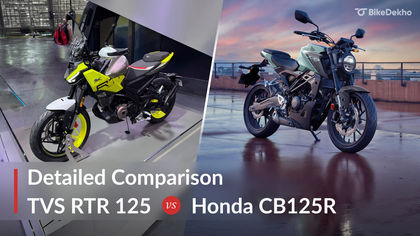
The TVS RTR 125 and the Honda CB125R take different approaches to styling despite belonging to the same 125cc street motorcycle category. The RTR 125 has a sharp, aggressive design, with a compact fuel tank, large tank extensions and an angular front section.
-
The Honda CB125R, on the other hand, gets a round LED headlight with a distinctive bezel, a minimalist front section and a muscular-looking fuel tank. Its exposed frame and compact proportions give it a more understated appearance than the RTR 125.
-
While the RTR 125 looks more like a conventional sporty streetfighter, the CB125R combines modern naked-bike styling with retro-inspired elements.

Underpinnings
|
Specifications |
TVS RTR 125 |
Honda CB125R |
|
Front suspension |
KYB Inverted fork |
Inverted fork |
|
Rear suspension |
KYB Monoshock |
Monoshock |
|
Front brake |
Disc brake |
Disc brake |
|
Rear brake |
Disc brake |
Disc brake |
The TVS RTR 125 gets an inverted front fork and a rear monoshock, both supplied by KYB. This is a sporty suspension setup for a motorcycle in the 125cc segment. The Honda CB125R also gets an upside-down front fork, but it uses a 41mm Showa SFF-BP unit. Both motorcycles feature disc brakes at either end. The CB125R gets a 296mm front disc with a radial-mount four-piston caliper and a 220mm rear disc with a single-piston caliper. The RTR 125, meanwhile, gets ByBre calipers at both ends. Both motorcycles also get dual-channel ABS. The RTR 125 gets switchable dual-channel ABS.
Features
|
Specifications |
TVS RTR 125 |
Honda CB125R |
|
Full-LED lighting |
Yes |
Yes |
|
Bluetooth connectivity |
Yes |
Yes |
|
USB charging |
Yes |
Yes |
|
Instrument Console |
5-inch TFT display |
5-inch TFT display |
|
ABS |
Switchable dual-channel ABS |
Dual-channel ABS |
Both motorcycles get full-LED lighting and a 5-inch TFT instrument console. The RTR 125's display supports Google Maps mirroring and other connectivity features, giving it a more extensive features package for a 125cc motorcycle. The bike also gets ride modes, allowing riders to alter its performance characteristics depending on their requirements. The Honda CB125R also gets a 5-inch full-colour TFT display. It shows essential information such as speed, fuel level, fuel consumption and gear position.
Performance
|
Specifications |
TVS RTR 125 |
Honda CB125R |
|
Engine |
125cc, 4-valve, liquid-cooled DOHC |
124.9cc, single-cylinder, liquid-cooled engine |
|
Power |
14.9PS at 9,000rpm |
14.95PS at 10,000rpm |
|
Torque |
12Nm at 7,000rpm |
11.96Nm at 8,000rpm |
|
Gearbox |
6-speed with slipper clutch |
6-speed with slipper clutch |
Both motorcycles are powered by liquid-cooled, single-cylinder engines with four-valve DOHC configurations. The RTR 125 gets a 125cc motor producing 14.9PS at 9,000rpm and 12Nm at 7,000rpm. The Honda CB125R, meanwhile, uses a slightly smaller 124.9cc engine that produces 14.95PS at 10,000rpm and 11.6Nm at 8,000rpm.
The two motorcycles are closely matched in terms of peak power, with the CB125R holding a marginal advantage. However, the RTR 125 produces slightly more torque, and it does so at a lower engine speed. This could give it a small advantage in terms of low- and mid-range response, although actual performance will also depend on gearing and overall engine tuning.
Both motorcycles get six-speed gearboxes. The RTR 125 also gets a slip-and-assist clutch, which should reduce lever effort and help manage rear-wheel behaviour during aggressive downshifts.
Verdict
The TVS RTR 125 and the Honda CB125R offer similarly powerful engines, but their overall packages have some notable differences. The RTR 125 has a sharper streetfighter design, KYB suspension, switchable dual-channel ABS and a feature-rich TFT console with Google Maps mirroring. Its slightly higher torque output and slip-and-assist clutch also give it an edge in some aspects of its powertrain package.
The Honda CB125R, meanwhile, stands out with its Neo Sports Café styling, 41mm Showa SFF-BP front fork and IMU-managed dual-channel ABS. It also has a marginal advantage in peak power, although the RTR 125 produces more torque.
On paper, the RTR 125 appears to offer a more extensive connectivity package, while the CB125R has the advantage in terms of its suspension and braking hardware. Both motorcycles have plenty to offer in the 125cc street motorcycle category, and the better choice will depend on whether a buyer prioritises the RTR 125's aggressive styling and technology or the CB125R's premium mechanical components.